
Context
Finding the shortest path between two points is straightforward. The problem becomes exponentially more complex when many destinations must be assigned across multiple vehicles and real-world constraints—such as vehicle availability, traffic, delivery requirements, capacity, schedules and travel time—must be considered together.
Solution
SmartRoute models destinations, available vehicles and relevant business constraints to calculate feasible route plans.
The optimization engine evaluates factors such as vehicle availability, traffic congestion, delivery requirements, travel distance and time when determining the best available routing sequence.
Stops are assigned across multiple vehicles and ordered to reduce avoidable travel while respecting configured operational rules.
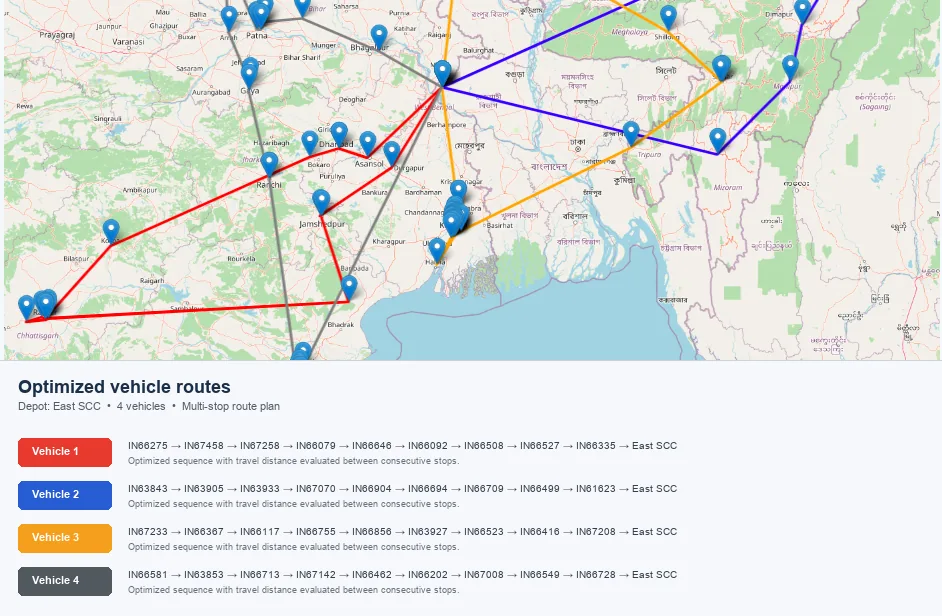
A web-based map visualizes each vehicle route in a distinct color and provides the ordered location sequence for operational review.
The completed proof of concept demonstrates the feasibility of extending the platform to scheduling, task assignment, packing, loading and broader logistics planning.
Potential benefits
Benefits are working hypotheses to validate against the target data, workflow and operating environment.
- Reduces distance and avoidable travel time
- Improves fleet utilization
- Makes route decisions visible and reviewable
- Supports lower delivery cost and better planning
Where SmartRoute Can Be Used
- Delivery Route Optimization
- Fleet Routing
- Field-service Routing
- Multi-stop Journey Planning
- Workforce Movement Optimization
- Logistics Optimization
- Cost and Time Optimization
Product workflow
Prototype screens use demonstration data and illustrate the workflow rather than a production deployment. Interfaces and outputs are configured for each organization.
Third-party names and interfaces, where visible, identify demonstration context only. Their marks belong to their respective owners and do not imply endorsement or partnership.
Multi-vehicle Route Plan
Turn a complex destination network into an actionable plan
SmartRoute divides destinations among available vehicles, sequences the stops and presents each route visually. The location list beneath the map gives dispatch teams a reviewable route order for every vehicle before execution.
How this implementation works
- The operator provides the service region, depot, available vehicles and the destinations that must be covered.
- Each destination is represented by an internal location identifier, shown here with the IN prefix, and associated with its geographic coordinates and applicable delivery requirements.
- The optimization engine evaluates possible stop assignments and sequences across the available fleet while considering configured constraints such as travel distance, time, traffic, availability and service rules.
- Destinations are distributed across four vehicles, and each optimized route is drawn in a different color so planners can review vehicle coverage and identify overlaps or exceptions.
- Below the map, SmartRoute provides the ordered location sequence for every vehicle, from the depot through each assigned stop and back to the depot.
- The proof of concept establishes the feasibility of expanding the same optimization approach to route scheduling, task assignment, vehicle loading and end-to-end logistics planning.
Responsible deployment
Production use requires fit-for-purpose evaluation, privacy and security controls, clear human accountability, monitored performance, and a fallback for uncertain or harmful outputs.
- Validate output quality against representative data and agreed acceptance measures before production use.
- Keep an accountable person in control of consequential decisions and exception handling.
- Limit access, collection and retention to the documented business purpose.