
Context
Manual observation cannot reliably cover large operational facilities around the clock. Safety teams needed a scalable way to detect distancing and mask-policy violations and retain reviewable evidence.
Solution
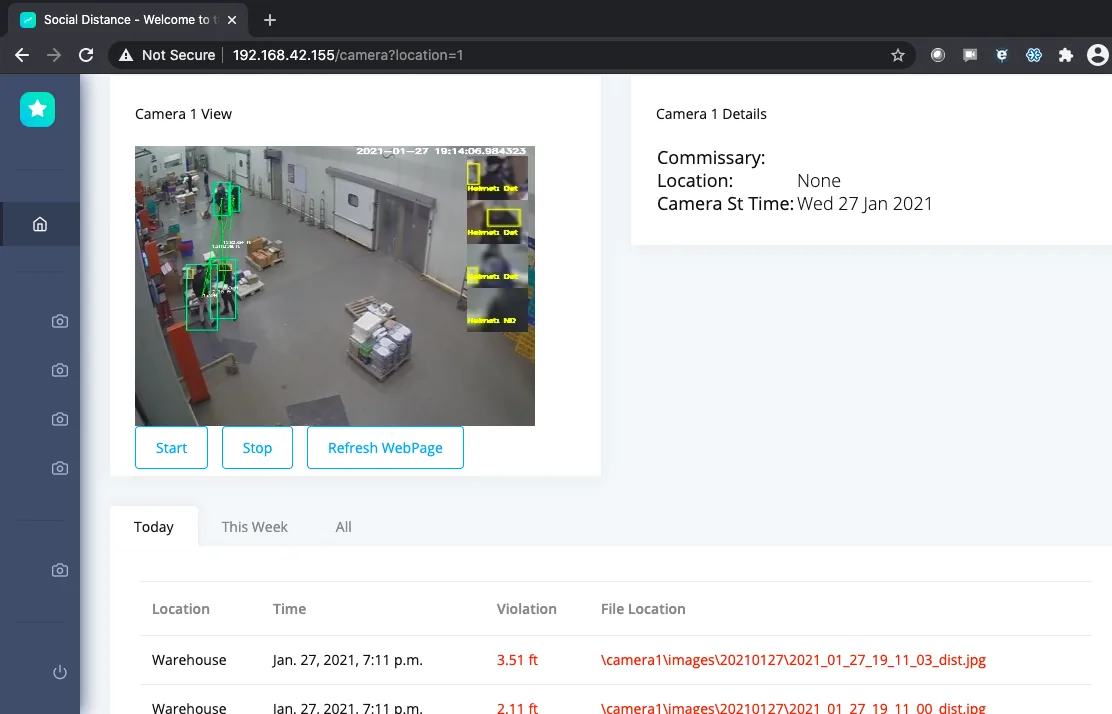
The application detects people in security-camera frames, estimates proximity, identifies configured violations, and presents live views and captured incidents in a web dashboard for manager review.
Potential benefits
Benefits are working hypotheses to validate against the target data, workflow and operating environment.
- Extends monitoring across shifts and locations
- Enables corrective and preventive action
- Creates a reviewable incident record
- Reduces dependence on continuous manual observation
Where SafeSense Can Be Used
- Manufacturing Plants
- Warehouses
- Construction Sites
- Healthcare Facilities
- Retail Environments
- Transport Hubs
- Protective Equipment Compliance
- Workplace Incident Prevention
Product workflow
Prototype screens use demonstration data and illustrate the workflow rather than a production deployment. Interfaces and outputs are configured for each organization.
Third-party names and interfaces, where visible, identify demonstration context only. Their marks belong to their respective owners and do not imply endorsement or partnership.
How this implementation works
- The application analyzes security-camera feeds to determine whether workers at supply-chain facilities are maintaining the required physical distance.
- When the distance between workers falls below six feet, the system captures the violation instance for review.
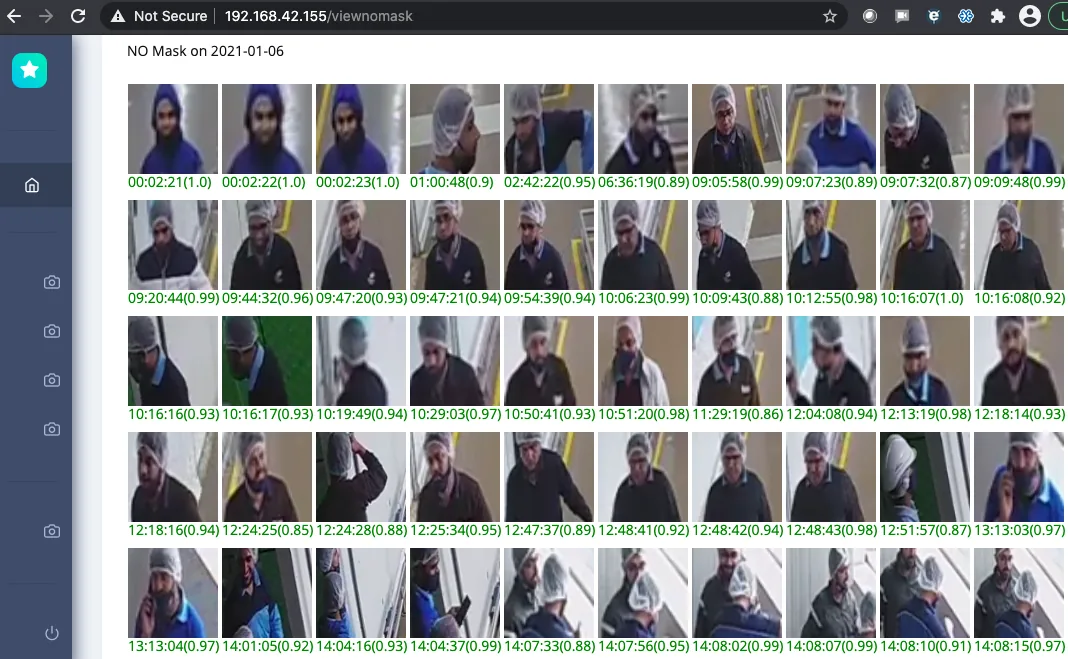
- The application also checks whether workers are wearing protective masks and records detected compliance violations.
- A web-based dashboard allows managers to review social-distancing and mask-compliance violations, with a consolidated view across multiple locations.
- Managers can also access live security-camera feeds through the web interface to assess conditions and take timely corrective action.
Responsible deployment
Production use requires fit-for-purpose evaluation, privacy and security controls, clear human accountability, monitored performance, and a fallback for uncertain or harmful outputs.
- Define safety purposes and worker notice before deployment, with consultation where required.
- Validate detection performance across clothing, lighting, body types and camera positions.
- Use alerts to support safety review rather than automatic disciplinary decisions.