
Context
Final inspection depended on a busy operator remembering a wide product range and noticing portioning or preparation defects. Missed defects created remake cost, customer complaints, and reputation risk.
Solution
Uses camera-based computer vision to inspect prepared food in real time.
Identifies and verifies key product attributes such as size, type, ingredients, toppings, quantity and product identity.
Checks whether ingredients and portions comply with prescribed quality and portioning standards.
Detects visual anomalies or defects that may affect product quality.
Generates a real-time quality inference to help operators determine whether the product is ready for dispatch.
Maps inspection results to the relevant order or transaction reference for traceability.
Stores inspection data and product images on the server for quality review, audit and analysis.
Provides a web-based interface for reviewing inspection records, images, product attributes and quality decisions.
Potential benefits
Benefits are working hypotheses to validate against the target data, workflow and operating environment.
- Improves consistency before dispatch
- Supports less-experienced operators
- Creates evidence for complaint review
- Reduces direct and indirect defect cost
Where FoodSight Can Be Used
- Quick-service Restaurants
- Commercial Kitchens
- Food Manufacturing
- Portion and Topping Verification
- Packaging Inspection
- Defect Detection
- Dispatch Quality Checks
- Complaint Investigation
Product workflow
Prototype screens use demonstration data and illustrate the workflow rather than a production deployment. Interfaces and outputs are configured for each organization.
Third-party names and interfaces, where visible, identify demonstration context only. Their marks belong to their respective owners and do not imply endorsement or partnership.
Real-time Food Quality Inspection
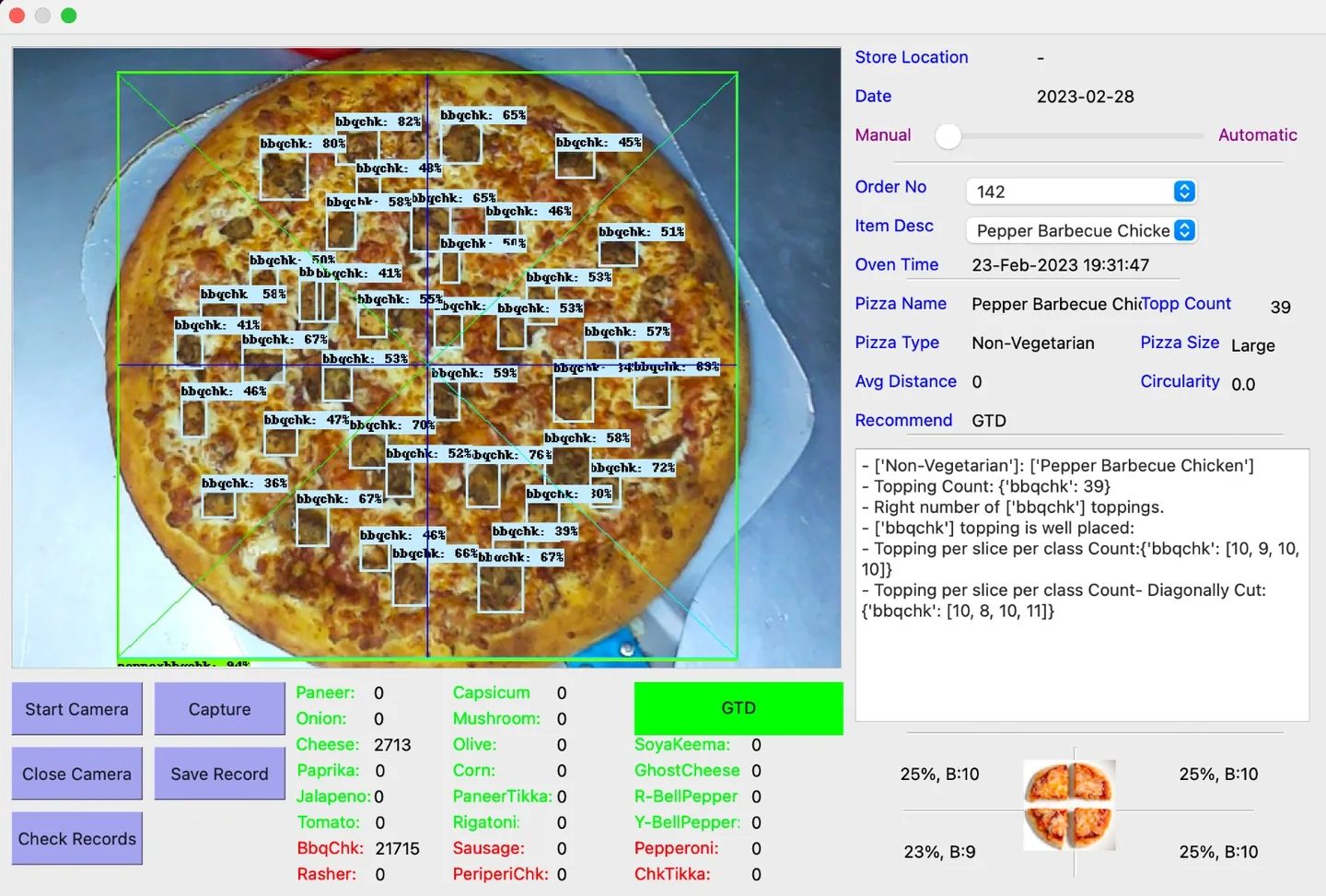
Verify product identity and topping count
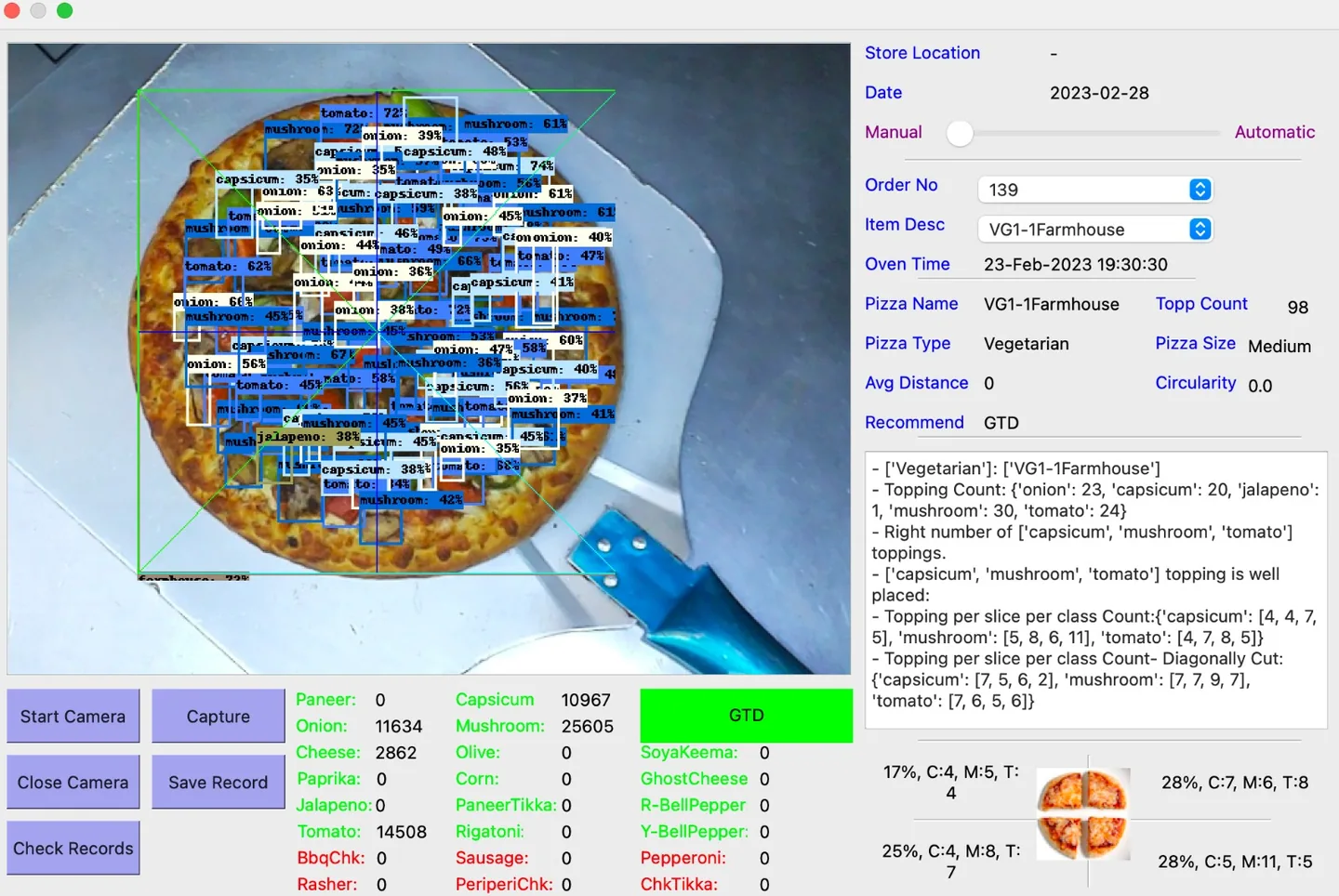
FoodSight identifies the pizza, size and type, detects individual topping instances, and compares their quantity and placement with the expected product specification before returning a quality decision.
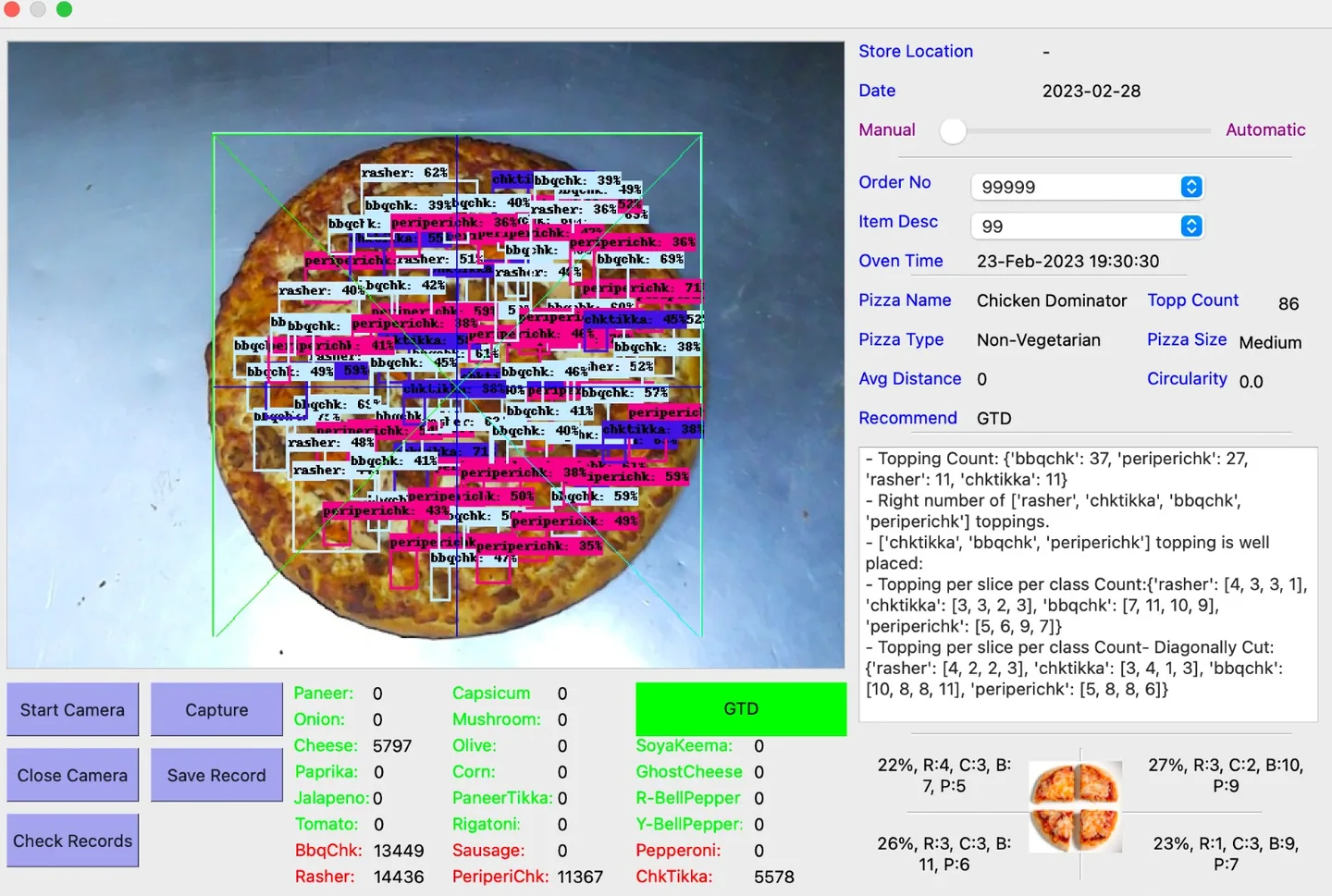
Inspect complex product configurations
Multiple ingredient classes are detected simultaneously and evaluated by virtual slice, allowing the system to assess whether a more complex pizza contains the right toppings in appropriate quantities.
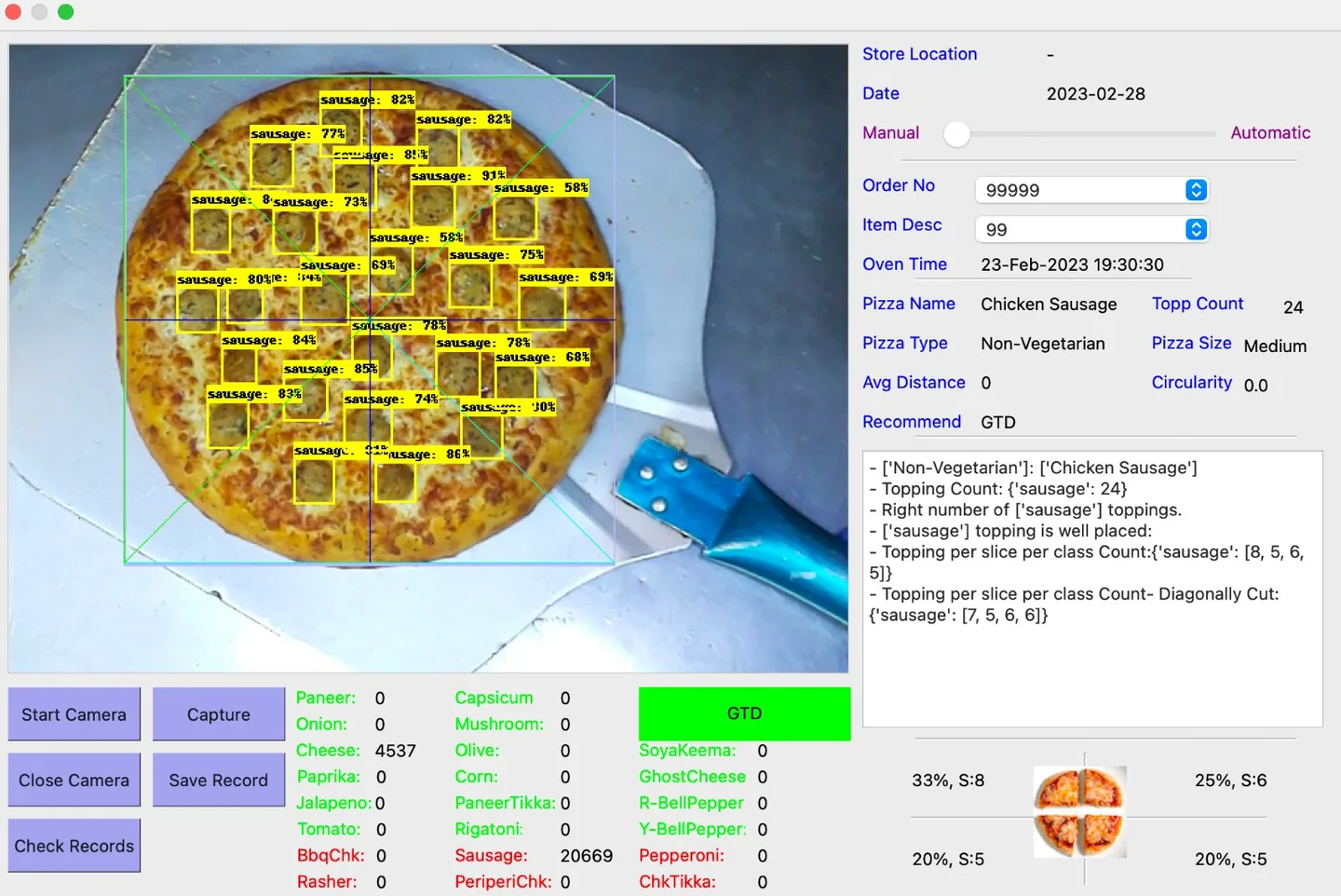
Measure distribution across every slice
The product is divided into virtual slices and topping counts are calculated for each section. This makes uneven distribution visible and supports consistent portioning across the full pizza.
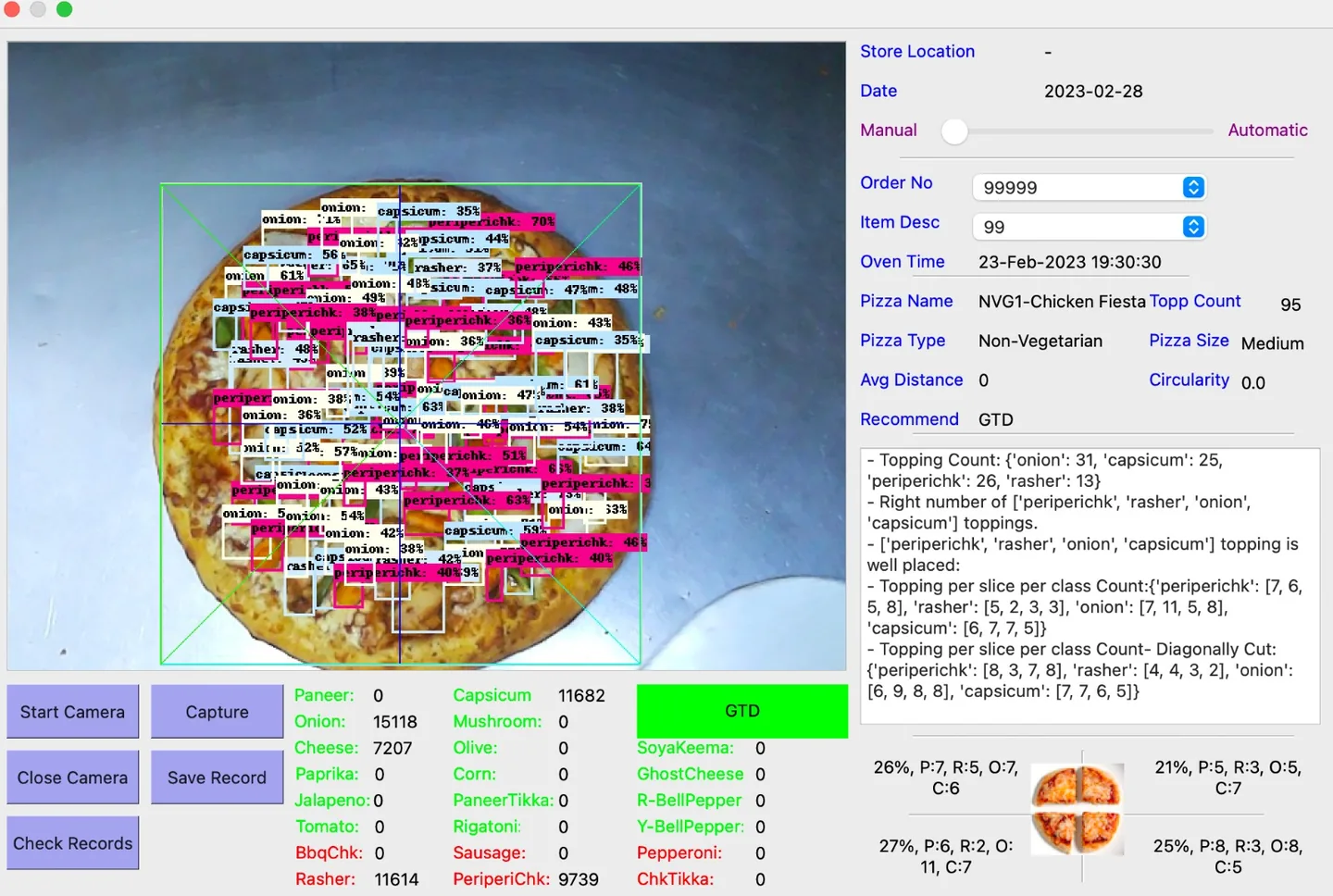
Compare preparation with defined standards
Detected ingredient quantities and placement are compared with prescribed portioning rules, giving the operator a consistent, evidence-based quality check before dispatch.
Support different products with one workflow
The same inspection workflow handles vegetarian and non-vegetarian products, records order-linked attributes and images, and provides a real-time recommendation for operator review.
How this implementation works
- FoodSight combines camera hardware and computer-vision software to inspect each prepared pizza at the cutting table and advise the operator whether it meets dispatch standards.
- The system determines pizza size—regular, medium or large—and classifies the product as vegetarian or non-vegetarian.
- It recognizes approximately 16 vegetarian and non-vegetarian topping types and identifies the pizza from a catalogue of more than 45 products.
- Detected toppings are counted within each virtual slice and compared with the prescribed food-portioning chart to assess quantity and distribution.
- The inspection can identify visible quality defects, including air bubbles, that may affect the finished product.
- Each result is associated with the relevant point-of-sale order number to provide traceability from preparation to dispatch.
- A real-time quality inference helps the oven operator decide whether the pizza is suitable for dispatch or requires corrective action.
- Product attributes, inspection results and the pizza image are stored on the server and made available through a web application for later quality review, audit and analysis.
Responsible deployment
Production use requires fit-for-purpose evaluation, privacy and security controls, clear human accountability, monitored performance, and a fallback for uncertain or harmful outputs.
- Validate image coverage and thresholds against approved product standards and representative operating conditions.
- Keep trained quality staff responsible for ambiguous or consequential rejection decisions.