
Context
Cold-storage doors are opened frequently during operations. When a door is unintentionally left open, warm air enters, refrigeration equipment runs longer, energy cost rises, and product or equipment risk increases.
Solution
A camera-based model identifies whether each door is open or closed, records its state, and sends an alert when the open duration exceeds the configured threshold. A web interface retains violation data and a short evidence clip for later review.
Potential benefits
Benefits are working hypotheses to validate against the target data, workflow and operating environment.
- Prompts timely corrective action
- Reduces avoidable electricity consumption
- Supports preventive maintenance and audit
- Provides data for energy-bill analysis
Where StateWatch Can Be Used
- Warehouse Door Monitoring
- Fire-exit Door Monitoring
- Machine Status Monitoring
- Safety Equipment Monitoring
- Cabinet and Access Monitoring
- Gate Monitoring
- Equipment Position Monitoring
Product workflow
Prototype screens use demonstration data and illustrate the workflow rather than a production deployment. Interfaces and outputs are configured for each organization.
Third-party names and interfaces, where visible, identify demonstration context only. Their marks belong to their respective owners and do not imply endorsement or partnership.
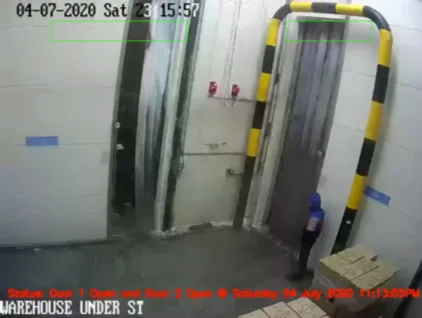
How this implementation works
- A security camera positioned in front of the deep-freezer doors enables the computer-vision application to identify whether each door is open or closed and record its state.
- If a door remains open for more than 180 seconds, an email alert is sent to the responsible manager.
- A web-based dashboard allows managers to review recorded violation instances at their convenience.
- Web based tool also provide access to 3 minutes door ajar violation video for later reference.
Responsible deployment
Production use requires fit-for-purpose evaluation, privacy and security controls, clear human accountability, monitored performance, and a fallback for uncertain or harmful outputs.
- Validate output quality against representative data and agreed acceptance measures before production use.
- Keep an accountable person in control of consequential decisions and exception handling.
- Limit access, collection and retention to the documented business purpose.